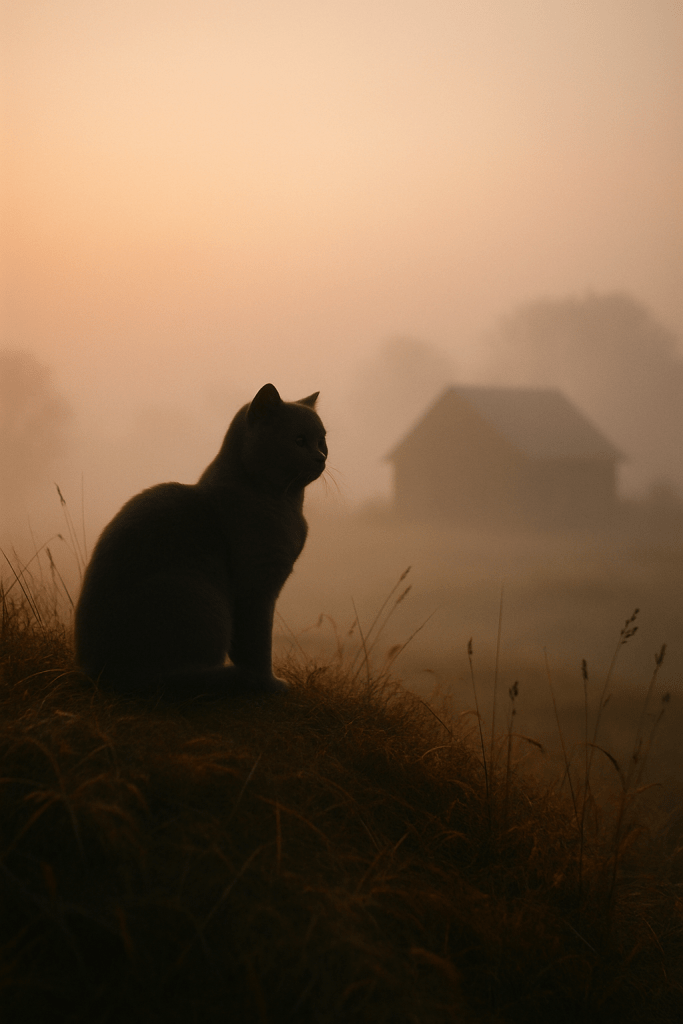
June began the way it always does in this part of the world. Heavy with green. Dew sticking to your ankles like ghosts as you walk through the tall grass at 6 a.m., coffee in hand, before the flies come out and the day starts its slow boil. On mornings like this, Missus Mary didn’t believe in God, but she did believe in chores. Cows don’t care if you’re tired. Tomatoes don’t prune themselves. And the mice don’t wait for your schedule.
That’s when she first noticed him.
Tomcat.
Not a tomcat. Not just any stray. But Tomcat — capital T. Black and white with blue eyes like glacier runoff. Long-furred, silky, like some indoor aristocrat had taken a wrong turn into reality. There was something about him. The way he moved. The way he didn’t beg, just existed beside her, like a ghost she hadn’t invited but didn’t mind sharing space with. And maybe that’s how it starts — this quiet agreement between woman and beast. She tossed him scraps. Old milk. Occasionally a cracked egg. Never reached out to touch him, never called him anything, but he was always there. Watching. Following her at a respectable distance. Like he knew better than to ask for more.
Missus Mary wasn’t the sentimental type. She’d buried pets. Buried people. She didn’t cry at weddings, and she didn’t believe in soulmates — not for humans, not for animals. But something about that damn cat made the barn feel fuller. More alive.
Then came the girl.
A tiny thing. Barely out of kittenhood herself. Dusty gray with yellow eyes, silent as smoke. She stayed on the edges at first — by the compost pile, the woodpile, the half-fallen shed. But Tomcat brought her closer, led her to the barn like a boy bringing his girl home to meet the parents. He watched her eat first, waited for her to finish. Never took his eyes off her. They curled up together in the rafters. Whispered to each other in meows and tail flicks. She never came inside without him. And Mary noticed. She pretended not to. But she saw.
Then one day, he didn’t show up.
Not that morning.
Not the next.
Not the one after that.
The gray girl sat on the little hill by the oak tree, where she could see the barn door from a distance. Waiting. Watching. She didn’t cry. Cats don’t. But she didn’t move much, either. And that was worse.
Missus Mary told herself she didn’t care. It was just a barn cat. Things die all the time on a farm. Rats. Chickens. Hopes. But she checked the hill every morning now. And on the fourth day, when the girl still hadn’t left, she poured some milk and left it on the edge of the barn. Didn’t look back.
That week, she found out. The neighbor, the one with the racing pigeons. Pale birds that fluffed like clouds and strutted like they owned the damn sky. He’d lost a few recently. Said something about feathers in the dirt. Said something about catching the bastard red-pawed. Said he had no choice. Shot him on the spot. Didn’t even blink.
Mary didn’t say a word. She didn’t yell. Didn’t protest. Didn’t call him a bastard or a murderer, even though she wanted to. She just nodded. What was there to say? Who raises hell over a nameless stray?
But a few nights later, the girl cat crept into the barn. Alone. She sniffed the corners. Climbed up into the hayloft. Settled into a patch of warm straw like she belonged there. And there, under the quiet buzz of a June night, she had her kittens.
Four of them. Three scrawny, wild-eyed little fighters. And one — one that looked just like him. Fluffy. Black and white. With eyes like glacier runoff.
Life on a farm doesn’t stop. The hay still needs turning. The calves still bawl for milk. The fox still creeps in at night. But now, Missus Mary checks the loft each morning. Leaves out extra scraps. Doesn’t name them. Wouldn’t dare. But every now and then, she talks to the mother in a voice just slightly softer than usual.
The little one, the Tomcat twin, already follows her around. Trips her up. Meows like he’s got something to say.
Barn cat life is not easy.
It never was.
They are born into weather, into risk, into hunger. They learn quickly — about fences and men with guns and the kind of silence that settles after loss. But some of them find ways to make ghosts into something holy. A shadow that lingers. A fur-lined echo.
Some lives don’t need names to be remembered.
Some stories don’t end where you think they will.

 Lady Liberty Writes